How to Choose Driveway Fabric for Gravel Roads
Driveway fabric provides a practical geotextile solution for separating aggregate from subgrade soil and improving the stability of gravel driveways and access roads. For contractors, distributors, and project buyers, selecting the correct material can reduce aggregate migration, limit rutting, and create a more reliable road base. Geofantex supplies woven and nonwoven geotextiles with different specifications, roll sizes, and mechanical properties for project requirements.
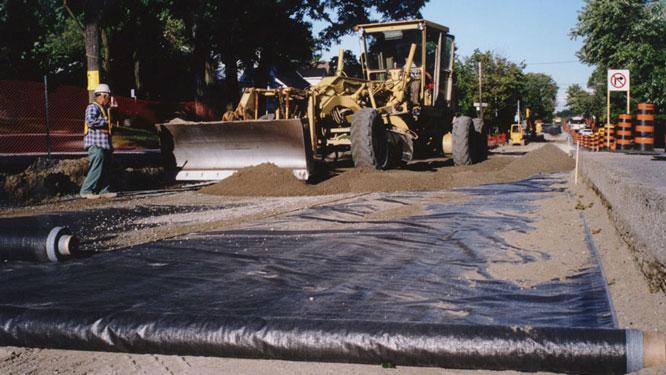
Why Use Driveway Fabric Under Gravel?
A gravel road depends on a stable base. When aggregate is placed directly over soft or fine-grained soil, vehicle loads can gradually push stone downward while soil particles migrate upward. This mixing weakens the aggregate layer and can contribute to rutting, depressions, and repeated maintenance.
A geotextile installed between the subgrade and aggregate acts as a separation layer. It helps maintain the integrity of the road base while distributing stresses during construction and service.
For projects where stabilization is the main requirement, buyers can review our driveway fabric for gravel road stabilization to compare suitable geotextile solutions for different soil and traffic conditions.
This approach is commonly considered for residential driveways, private roads, farm access routes, construction roads, parking areas, and other unpaved traffic surfaces.
Woven vs. Nonwoven Driveway Fabric
Woven and nonwoven geotextiles perform different functions, so purchasing decisions should be based on project conditions rather than product weight or price alone.
Woven polypropylene geotextiles provide high tensile strength and dimensional stability. They are frequently used where separation and stabilization are important, especially over weak subgrades exposed to regular vehicle traffic.
Nonwoven needle-punched geotextiles offer high permeability and filtration performance. They are widely used in drainage systems, filtration layers, erosion-control projects, and applications where water movement through the geotextile is important.
Buyers who need to compare these materials can explore woven driveway fabric for road construction before confirming the required specification.
For some projects, the appropriate selection may depend on soil type, drainage conditions, aggregate thickness, axle loads, installation method, and engineering specifications.

Specifications to Check Before Ordering
A professional quotation should be based on technical requirements rather than roll price alone. Two products with similar dimensions can have significantly different mechanical and hydraulic properties.
Important parameters may include tensile strength, elongation, puncture resistance, apparent opening size, permeability, polymer type, mass per unit area, roll width, and roll length.
For road stabilization, tensile and puncture performance can be particularly important because the material must withstand stresses generated during aggregate placement, compaction, and subsequent traffic.
Project buyers should also consider roll dimensions. Wider rolls may reduce the number of overlaps required on large sites, while optimized roll lengths can improve handling, loading, and installation efficiency.
How Much Material Should You Purchase?
Start by calculating the basic coverage area:
Road length × road width = total surface area
The final order quantity should also account for overlaps, edges, curves, irregular areas, and a reasonable installation allowance.
For example, a 60 m long and 5 m wide road requires a basic coverage area of 300 m² before overlaps and additional material are considered.
For commercial orders, Geofantex can help calculate roll quantities according to project dimensions and available product sizes. Buyers can also review driveway fabric specifications for gravel driveways when preparing technical and purchasing requirements.
Installation and Aggregate Placement
Before installation, the subgrade should be prepared and large debris, sharp objects, and unsuitable material removed. The geotextile is then unrolled over the prepared surface with appropriate overlaps between adjacent sections.
Aggregate should be placed carefully to avoid unnecessary displacement or damage to exposed material. Direct vehicle traffic over uncovered geotextile should generally be avoided. Once sufficient aggregate cover is installed, the road base can be graded and compacted according to project requirements.
Aggregate type and thickness should be determined according to soil strength, drainage conditions, expected traffic, and the overall pavement design.
Request a Driveway Fabric Quote from Geofantex
Geofantex manufactures and supplies geotextiles for road construction, soil stabilization, separation, filtration, and drainage applications. Woven and nonwoven options are available with different technical properties and roll dimensions for project and bulk purchasing requirements.
For an accurate recommendation and quotation, provide your project area, subgrade condition, expected vehicle loads, required specifications, preferred roll dimensions, quantity, and destination country or port.
Our team can review these requirements, recommend an appropriate geotextile specification, calculate the required quantity, and prepare a commercial quotation for your project.


Comments
Post a Comment