Geosynthetic Reinforcement for Ground Stabilization
Geosynthetic reinforcement provides engineers, contractors, and project buyers with practical solutions for improving weak soils, stabilizing aggregate layers, and controlling deformation. For road and embankment projects, selecting the correct geogrid, woven geotextile, or geocell can improve structural performance while helping optimize material use, installation efficiency, and long-term project costs.
How Does Geosynthetic Reinforcement Improve Road Performance?
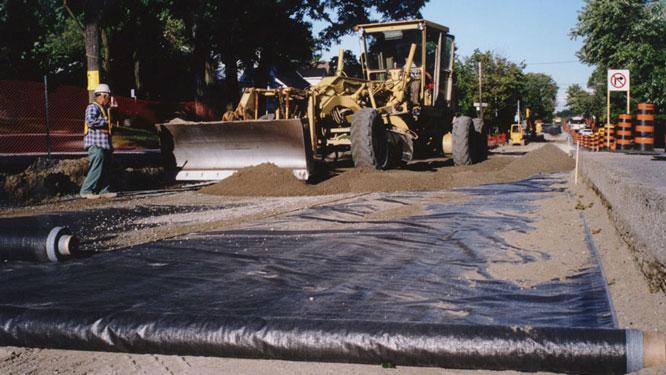
Roads constructed over weak or variable subgrades can experience rutting, lateral aggregate movement, differential settlement, and premature pavement deterioration. Adding thicker aggregate layers may help, but it does not always solve the underlying stability problem efficiently.
Geogrids are commonly installed between the subgrade and aggregate base to create mechanical interlocking with granular materials. This interaction restricts lateral movement and improves load distribution. Woven geotextiles can also provide tensile reinforcement while separating aggregate from soft subgrade soil.
For projects involving poor bearing conditions, geosynthetic reinforcement for weak subgrades can help maintain the integrity of the base layer and reduce contamination between different materials. Depending on the design, traffic loads, soil properties, and project requirements, this may contribute to improved construction stability and longer pavement service life.
Which Geosynthetics Are Suitable for Road Reinforcement?
Different geosynthetic products provide different reinforcement mechanisms, so product selection should be based on the engineering function rather than tensile strength alone.
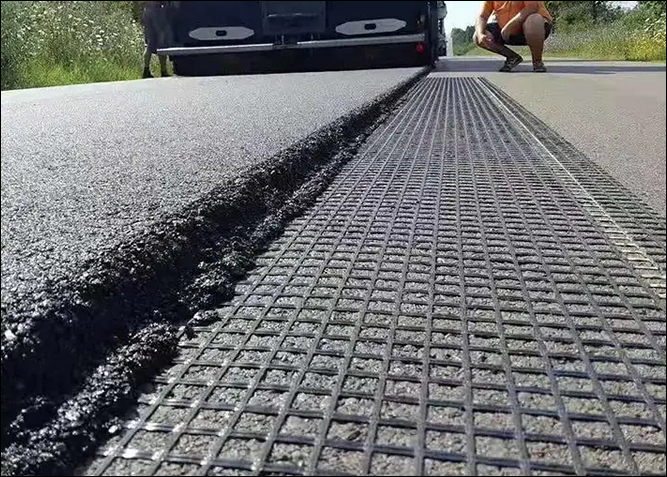
Biaxial and multiaxial geogrids are widely used in road bases, working platforms, access roads, and other applications where aggregate confinement is required. Their grid structure allows aggregate particles to interlock with the apertures, improving lateral restraint.
Woven geotextiles are often considered when a project requires both separation and reinforcement. They can help prevent soft subgrade soil from mixing with the aggregate layer while providing tensile resistance.
Geocells provide three-dimensional confinement. When filled with aggregate or soil, the cellular structure limits lateral displacement and distributes loads across a wider area. They are especially useful for unpaved roads, working platforms, slopes, and areas where localized confinement is required.
Material selection should consider tensile properties, aperture size, polymer type, elongation, soil conditions, traffic loading, installation requirements, and relevant engineering standards.
How Is Geosynthetic Reinforcement Used in Embankments?
Soft foundation soils beneath embankments may have insufficient bearing capacity or excessive deformation potential. Without appropriate stabilization measures, construction can result in lateral spreading, uneven settlement, or reduced overall stability.
Reinforcing materials can be installed at the base of an embankment to provide additional tensile resistance and improve the interaction between fill material and weak foundation soil. High-strength woven geotextiles and geogrids are commonly considered for this type of application.
Properly designed geosynthetic reinforcement for embankment stability can support construction over soft ground while helping control deformation during filling and consolidation. However, product specification should always be determined through engineering calculations that consider soil strength, embankment height, loading conditions, drainage, settlement behavior, and the required design life.
For critical infrastructure, long-term design strength, creep behavior, installation damage factors, and durability should also be evaluated instead of relying solely on short-term tensile strength.
What Should Buyers Check Before Ordering Reinforcement Materials?
Procurement decisions should begin with the project specification and application conditions. Two products with similar nominal tensile strengths may perform differently because of differences in polymer type, manufacturing method, junction efficiency, elongation, aperture configuration, and long-term properties.
Buyers should provide suppliers with the required tensile strength, roll dimensions, aperture size, polymer type, applicable testing standard, project application, and estimated quantity. For road and embankment projects, information about soil conditions and structural requirements can also help manufacturers recommend a more appropriate product.
When evaluating a geosynthetic reinforcement supplier for road projects, buyers should request technical data sheets, relevant laboratory test reports, quality-control documentation, production information, packaging details, and available certifications. For customized specifications, dimensional tolerances and production feasibility should be confirmed before placing a bulk order.
A technically suitable product should satisfy the engineering requirements of the project while also providing consistent manufacturing quality and practical installation characteristics. Reviewing the complete specification before purchasing can reduce the risk of material mismatch, site delays, and unnecessary replacement costs.


Comments
Post a Comment