Composite Drain Applications in Civil Engineering Projects
Composite drain systems provide an efficient solution for engineers, contractors, and buyers seeking reliable drainage for roads, reservoirs, retaining structures, and other civil engineering projects. By combining a drainage core with geotextile filtration layers, these geosynthetic products can reduce the need for thick granular drainage layers while providing controlled hydraulic performance, easier installation, and consistent factory-manufactured properties.
What Is a Composite Drain and How Does It Work?
A drainage geocomposite normally consists of a polymer drainage core bonded to one or two geotextile layers. The core creates channels for in-plane water flow, while the geotextile allows water to enter the system and helps prevent surrounding soil particles from migrating into the drainage structure.
This combination enables filtration, separation, and drainage within one manufactured product. For project designers, hydraulic transmissivity, compressive behavior, geotextile permittivity, opening size, and long-term flow capacity are important selection parameters.
For projects requiring technical product information, buyers can review composite drain specifications for civil engineering before selecting thickness, drainage-core configuration, and filtration properties.
Where Is Composite Drain Used in Civil Engineering?
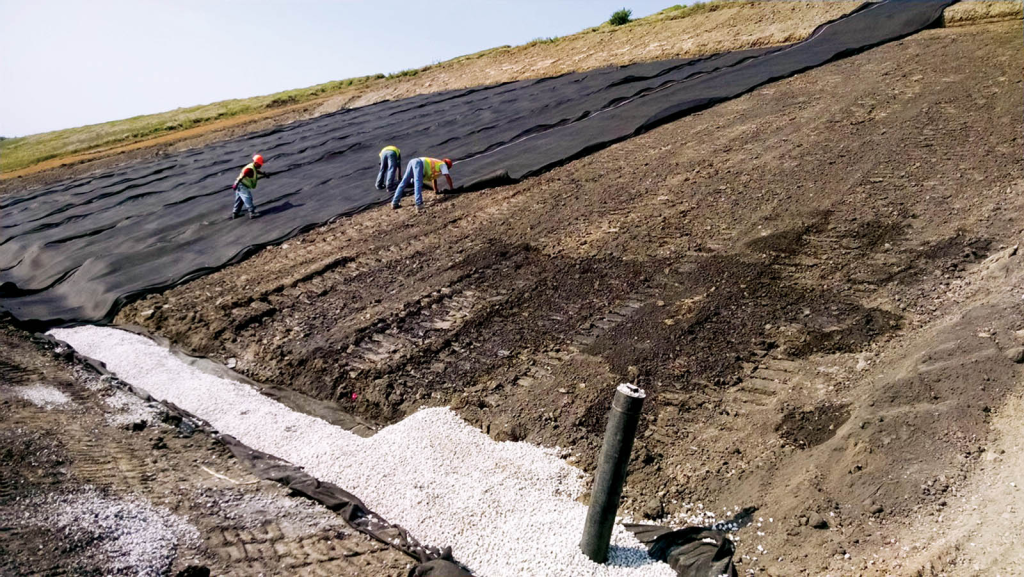
These systems are suitable for projects where engineers need to collect and transport subsurface water while retaining surrounding soil. Typical applications include highway subbases, retaining walls, tunnels, landfills, foundations, slopes, reservoirs, hydraulic structures, and wastewater facilities.
In road construction, drainage geocomposites help remove infiltrated water from pavement layers and subgrades. Controlling water can reduce hydraulic pressure and limit conditions that contribute to pumping, weakening of foundation materials, and premature pavement deterioration.
Water infrastructure is another growing application. Reservoirs, canals, dams, and water-management structures may require drainage layers behind or beneath lining and protection systems to control seepage and relieve water pressure.
Engineers working on transportation projects can also evaluate composite drain solutions for road drainage according to design flow, normal pressure, and site drainage conditions.
What Are the Main Advantages of Geosynthetic Drainage Composites?
These geosynthetic systems can provide substantial water-flow capacity within a relatively thin cross-section. This makes them particularly useful where excavation depth or construction space is limited. They can also help when transportation costs, structural weight, or aggregate availability create project constraints.
Other practical advantages include faster installation, predictable manufactured properties, reduced dependence on locally available drainage aggregate, easier transportation, and the ability to combine filtration and drainage functions in a single installed layer.
However, nominal laboratory flow capacity should not be the only purchasing criterion. Engineers should consider long-term normal stress, hydraulic gradient, creep, geotextile intrusion, installation damage, chemical exposure, and potential biological clogging.
How Do You Select the Right Composite Drain?
Selecting a composite drain should begin with project conditions rather than product thickness alone. Engineers should first identify the required drainage capacity and expected normal load, then assess whether the drainage core can maintain adequate flow under actual field conditions.
The geotextile filter should also be compatible with surrounding soil. Relevant parameters may include apparent opening size, permittivity, water-flow capacity, tensile strength, and puncture resistance.
For reservoir and hydraulic applications, designers should additionally consider seepage conditions, drainage outlets, hydrostatic pressure, long-term durability, and compatibility with adjacent geomembranes or other lining components.
From a procurement perspective, technical datasheets, laboratory test reports, manufacturing consistency, material traceability, and application support should be evaluated together. Buyers preparing a project specification can refer to composite drain manufacturer technical guidance when comparing drainage capacity, core structure, geotextile properties, roll dimensions, and project-specific requirements.
Correct product selection and installation help create a continuous drainage path, making geosynthetic drainage composites a practical solution for modern transportation, water-management, environmental, and underground engineering projects.


Comments
Post a Comment