Soil Reinforcement Geosynthetics: How to Choose Materials
Soil reinforcement geosynthetics help improve ground stability, distribute loads, and enhance infrastructure performance. For contractors, engineers, and procurement managers, choosing the right geogrid, geotextile, or geocell requires evaluating technical specifications, site conditions, and project costs. This guide explains how to compare reinforcement materials, identify suitable applications, and prepare purchasing requirements for an accurate supplier quotation.
Types of Soil Reinforcement Geosynthetics
Different geosynthetic products provide specific reinforcement and stabilization functions.
Geogrids for Structural Reinforcement
Geogrids are commonly used in road foundations, retaining walls, and embankments. Their open-aperture structure allows interaction with the surrounding soil or aggregate.
- Uniaxial geogrids: Suitable for reinforced soil walls and steep slopes requiring high tensile strength in one principal direction.
- Biaxial geogrids: Commonly used for road base stabilization and load distribution.
- Multiaxial geogrids: Designed to provide multidirectional stabilization in suitable aggregate systems.
Key specifications include tensile strength (kN/m), tensile stiffness, aperture dimensions, junction properties, and long-term durability.
Geotextiles for Separation and Stabilization
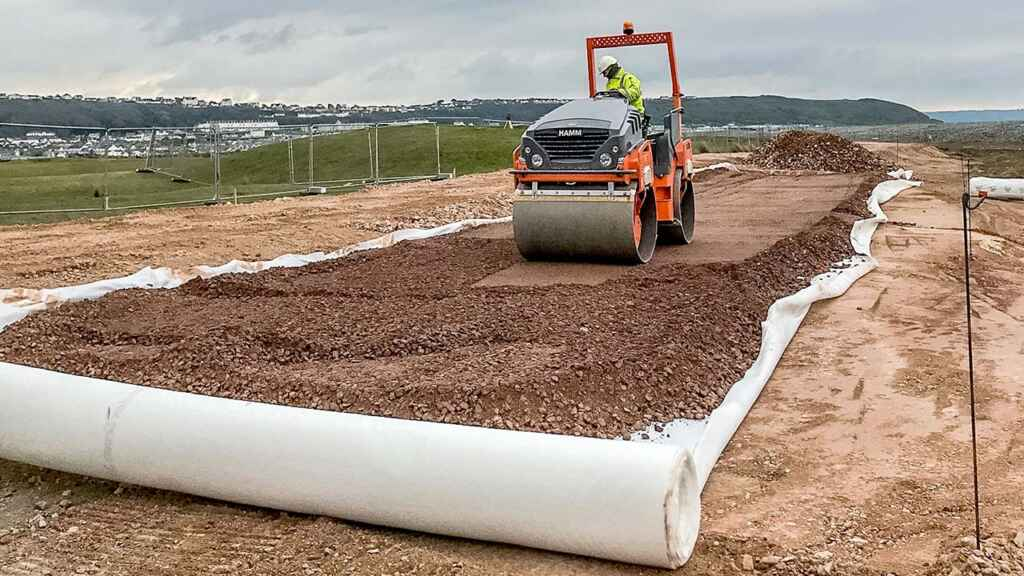
Woven geotextiles can provide tensile reinforcement and separation, while nonwoven geotextiles are primarily used for filtration, drainage, separation, and protection.
Buyers should compare tensile strength, elongation, puncture resistance, permeability, and mass per unit area (g/m²).
Geocells for Soil Confinement
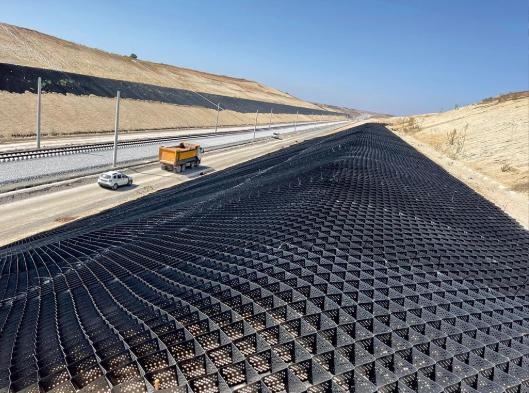
HDPE geocells form three-dimensional confinement systems that help stabilize granular infill and improve load distribution.
Important purchasing parameters include cell height, strip thickness, connection strength, expanded panel dimensions, and infill compatibility.
Soil Reinforcement Geosynthetics for Roads and Embankments
Product selection depends on the engineering application and expected loading conditions.
Road Construction and Subgrade Stabilization
Road foundations constructed over weak soils may experience rutting, settlement, and aggregate displacement.
Biaxial geogrids can improve aggregate confinement, while woven geotextiles provide separation and may contribute to tensile reinforcement.
For detailed product options, explore soil reinforcement geosynthetics for road construction to compare suitable reinforcement materials.
Embankment and Retaining Wall Construction
Reinforced embankments and retaining walls require materials capable of resisting tensile forces over the intended service life.
Uniaxial geogrids and high-strength woven geotextiles are common options, depending on the structural design.
Explore soil reinforcement geosynthetics for embankment stabilization when evaluating reinforcement products for earthworks and foundation improvement.
Slope Protection and Load Support
Geocells provide confinement for soil, aggregate, or other suitable infill materials. They are commonly used for slope protection, unpaved roads, and access platforms.
Cell dimensions, anchorage, slope geometry, and drainage conditions should be considered before selection.
Key Technical Specifications to Compare
When comparing products, buyers should focus on measurable engineering properties rather than product weight or price alone.
| Specification | Purchasing consideration |
|---|---|
| Tensile strength | Required reinforcement capacity (kN/m) |
| Tensile stiffness | Resistance to deformation under working loads |
| Elongation | Strain behavior under tensile loading |
| Polymer type | PP, PET, or HDPE material characteristics |
| Durability | Creep resistance, chemical resistance, and installation damage |
| Roll dimensions | Installation efficiency and shipping requirements |
| Testing standards | Verification using applicable ASTM or ISO test methods |
Request a Technical Data Sheet (TDS) and relevant test reports before confirming an order.
For permanent reinforcement applications, long-term design strength and reduction factors should also be reviewed.
Factors Affecting Product Pricing
The total purchasing cost depends on product grade, manufacturing requirements, order volume, packaging, and transportation.
Higher-strength materials or specialized performance requirements may increase production costs.
Roll width and diameter can affect container utilization, while destination ports and delivery terms influence freight costs.
For international purchasing, compare quotations using consistent specifications and Incoterms such as FOB, CFR, or CIF.
The lowest material price does not necessarily represent the lowest total installed cost.
What to Check Before Ordering
Before placing an order, confirm the following information:
- Project application and engineering requirements
- Soil conditions and expected loading
- Required tensile strength and other performance specifications
- Total quantity in square meters or rolls
- Preferred roll dimensions and packaging
- Applicable testing standards and documentation
- Delivery destination and required delivery schedule
- Minimum order quantity and payment terms
Buyers can also review soil reinforcement geosynthetics product specifications and purchasing options to identify suitable material grades.
Providing complete technical information helps reduce quotation delays and minimizes the risk of ordering unsuitable products.
Request a Quotation from Geofantex
Geofantex supplies geogrids, woven and nonwoven geotextiles, HDPE geocells, and other geosynthetic materials for infrastructure and civil engineering applications.
Our team can assist with product comparisons, technical documentation, and quotation preparation based on project requirements.
Whether you are sourcing soil reinforcement geosynthetics for road construction, embankment reinforcement, or ground stabilization, selecting appropriate specifications is essential for reliable performance and cost control.
Contact Geofantex with your project specifications, required quantity, intended application, and delivery destination. Include technical drawings or required standards, if available, to receive tailored product recommendations and a quotation.


Comments
Post a Comment