Geosynthetic Clay Liner Installation for Containment Projects
Geosynthetic clay liner installation is an important consideration for contractors and project owners sourcing reliable barrier systems for mining and landfill applications. Correct material selection, site preparation, deployment, overlap control, and covering help GCL systems achieve their intended hydraulic performance. For buyers planning new containment projects, understanding these installation requirements also makes it easier to select suitable GCL specifications, roll dimensions, and supporting geosynthetic materials before requesting quotations.
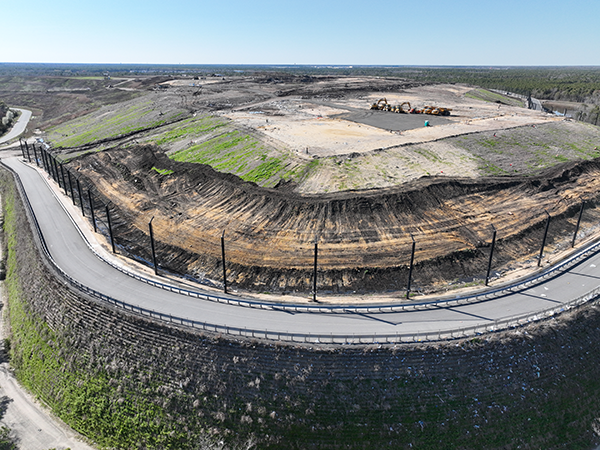
Why Geosynthetic Clay Liner Installation Matters
Geosynthetic clay liners (GCLs) are factory-manufactured hydraulic barriers typically consisting of sodium bentonite encapsulated between geotextile layers. Once properly confined and hydrated, the bentonite forms a low-permeability barrier that helps control liquid migration.
This structure makes GCLs particularly useful in landfill cells, mining containment facilities, leachate ponds, process-water ponds, reservoirs, and other environmental engineering projects.
Compared with constructing a thick compacted clay layer, GCL rolls can reduce the volume of natural clay that needs to be excavated, transported, placed, and compacted. This can simplify construction where suitable clay resources are limited or where site conditions make conventional clay barriers difficult to construct.
However, specifying the GCL alone is not enough. Subgrade conditions, overlap details, moisture exposure, slopes, penetrations, cover materials, and construction traffic should all be considered during project planning.
For contractors preparing a new site, reviewing a geosynthetic clay liner installation guide for containment projects before procurement can help identify potential construction requirements and select appropriate product specifications.
Subgrade Preparation and GCL Deployment
The receiving surface should generally be smooth, stable, and free of sharp objects, standing water, excessive vegetation, and irregularities that could interfere with intimate contact between the GCL and subgrade.
During deployment, rolls should be handled using suitable equipment and positioned according to the approved installation plan. Excessive dragging should be avoided because it can damage the geotextile components or disturb the bentonite layer.
Panel orientation also deserves attention on slopes. Project-specific drawings, manufacturer recommendations, and engineering specifications should determine the final deployment direction and anchoring requirements.
Overlaps, Seams, and Cover Placement
Adjacent GCL panels are normally installed with specified overlaps. Correct overlap dimensions and treatment are important because poorly constructed panel connections can create potential preferential flow paths.
Penetrations, corners, transitions, and damaged areas require particular attention. These details should be inspected and treated according to project specifications before the liner is covered.
After deployment and inspection, unnecessary exposure should be minimized. Timely placement of the specified cover material can protect the GCL from weather, construction damage, and unwanted hydration.
A geosynthetic clay liner installation checklist for contractors can therefore be useful for coordinating material receiving, deployment, overlap inspection, repairs, and final covering.
Geosynthetic Clay Liner Installation in Mining and Landfills
Mining and landfill projects often place demanding requirements on containment systems because large areas, slopes, drainage components, chemical exposure, and long-term environmental protection must be considered together.
In mining applications, GCLs may be incorporated into lining systems for process-water ponds, tailings-related facilities, secondary containment, and other engineered barrier applications. Depending on project conditions, the GCL may be combined with HDPE geomembrane, geotextile, geonet, or geocomposite drainage products.
Landfill projects commonly use multiple geosynthetic components to perform barrier, protection, separation, filtration, and drainage functions. A GCL can form part of a composite liner or cover system, while geomembranes provide additional containment and geocomposites facilitate drainage.
The final system should always be selected according to engineering design requirements, site conditions, applicable regulations, and chemical compatibility rather than choosing a liner based solely on unit price.
What Buyers Should Confirm Before Ordering
Before placing a GCL order, procurement teams should confirm key technical and commercial information such as project application, required GCL type, bentonite mass per unit area, tensile and peel properties, roll dimensions, total installation area, delivery schedule, and required testing documentation.
Buyers should also consider whether other geosynthetic products are required for the same system. Consolidating GCLs, geomembranes, geotextiles, drainage geocomposites, and related materials can simplify procurement and container planning for international projects.
For large mining or landfill projects, requesting a geosynthetic clay liner installation and product specification review before ordering can help align product selection with actual site requirements.
Geofantex supplies GCLs and complementary geosynthetic materials for environmental, mining, landfill, and hydraulic engineering applications. Contractors, distributors, and project procurement teams can provide drawings, specifications, required quantities, and application conditions for product evaluation and quotation.


Comments
Post a Comment