Geocell Ground Grid Applications, Benefits and Selection
Geocell ground grid is a three-dimensional cellular confinement system used to stabilize soil, aggregate, and other infill materials in roads, slopes, access routes, and erosion-control projects. For contractors, engineers, and buyers, selecting the correct cell depth, material, and infill is important for achieving the required load support and long-term project performance.
What Is a Geocell Ground Grid and How Does It Work?
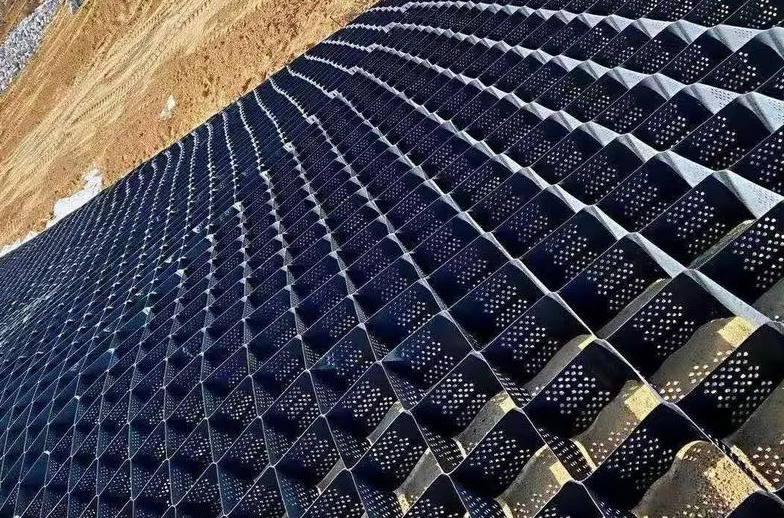
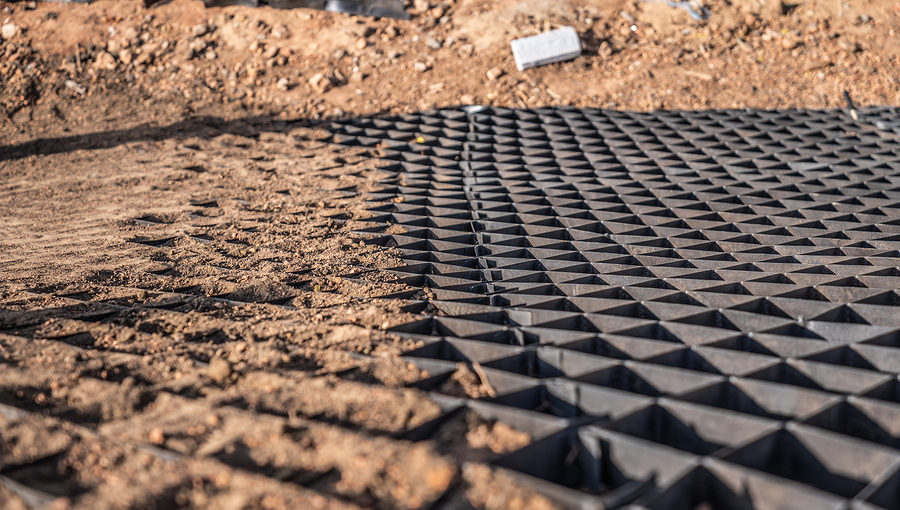
The system consists of interconnected polymer strips. When expanded, they form a honeycomb structure with individual cells. Contractors fill these cells with soil, sand, gravel, aggregate, or other specified materials.
The primary mechanism is cellular confinement. When loads are applied, the cell walls restrict lateral movement of the infill while transferring stresses between adjacent cells. This creates a more stable composite layer and helps distribute loads over a wider area.
Cellular-confined aggregate improves load distribution through geosynthetic reinforcement, passive resistance from material in adjacent cells, and transfer of vertical stresses between cells.
For projects involving weak or unstable ground, engineers can review our geocell ground grid stabilization solutions to compare cellular configurations for different subgrade conditions.
Where Is Geocell Ground Grid Commonly Used?
This type of reinforcement can serve both load-support and erosion-control applications.
For slope protection, expanded cells confine soil or aggregate on the slope surface, reducing material migration caused by rainfall, runoff, or gravity. Vegetated infill can also be used where landscaping and erosion control are required.
In road construction, cellular confinement can stabilize granular base materials and improve load distribution over weaker subgrades. Typical applications include unpaved roads, temporary access roads, parking areas, construction platforms, industrial yards, and road shoulders.
Learn more about geocell ground grid for road construction when designing access roads or pavement foundations over variable subgrade conditions.
What Are the Main Benefits of Geocell Systems?
The main advantage comes from three-dimensional confinement. A conventional aggregate layer can spread laterally when subjected to repeated loads. In contrast, cellular walls restrict this movement and keep the infill confined.
Important engineering benefits include improved load distribution, reduced lateral movement of infill, erosion protection, surface stabilization, and the potential use of locally available fill where permitted by the project design.
Geocells can also be combined with nonwoven geotextiles. When installed over fine-grained subgrade, the geotextile can provide separation and filtration while the geocell provides confinement and reinforcement.
Cellular confinement may reduce required granular layer thickness, permit the use of locally available marginal materials, or reduce maintenance requirements for gravel roads, depending on design conditions.
For projects where erosion resistance is the primary objective, see our geocell ground grid for slope protection options for embankments, channels, and exposed slopes.
How Do You Select the Right Geocell Specification?
Choosing the correct geocell ground grid requires more than comparing price per square meter. Engineers and procurement teams should evaluate subgrade strength, expected loading, slope angle, cell depth, cell dimensions, polymer properties, wall texture, perforation, weld or seam strength, infill type, anchoring, and drainage requirements.
Cell depth should be selected according to the required confinement and project conditions. Greater depth does not automatically mean a better design; the complete geocell-infill-subgrade system must be considered.
Installation quality is equally important. FHWA-related guidance recommends preparing and compacting the subgrade before placement. Where geocells are installed over fine-grained material, a nonwoven geotextile may be placed underneath to prevent mixing between aggregate and subgrade.
For procurement, buyers should provide project application, subgrade information, anticipated loads, required cell dimensions, infill material, and installation conditions. These details allow the manufacturer to recommend a more appropriate geocell configuration rather than selecting a product based only on unit price.
Geocell cellular confinement technology offers a practical method for stabilizing roads, slopes, embankments, and weak ground. By confining infill within a three-dimensional structure, geocells improve material stability and help distribute loads while supporting erosion-control requirements.
For engineering projects, matching cell geometry, material properties, infill, and installation method to actual site conditions is essential for achieving reliable long-term performance.


Comments
Post a Comment